They cut down eleven of my trees without asking.
Not trimmed. Not pruned. Not damaged by accident.
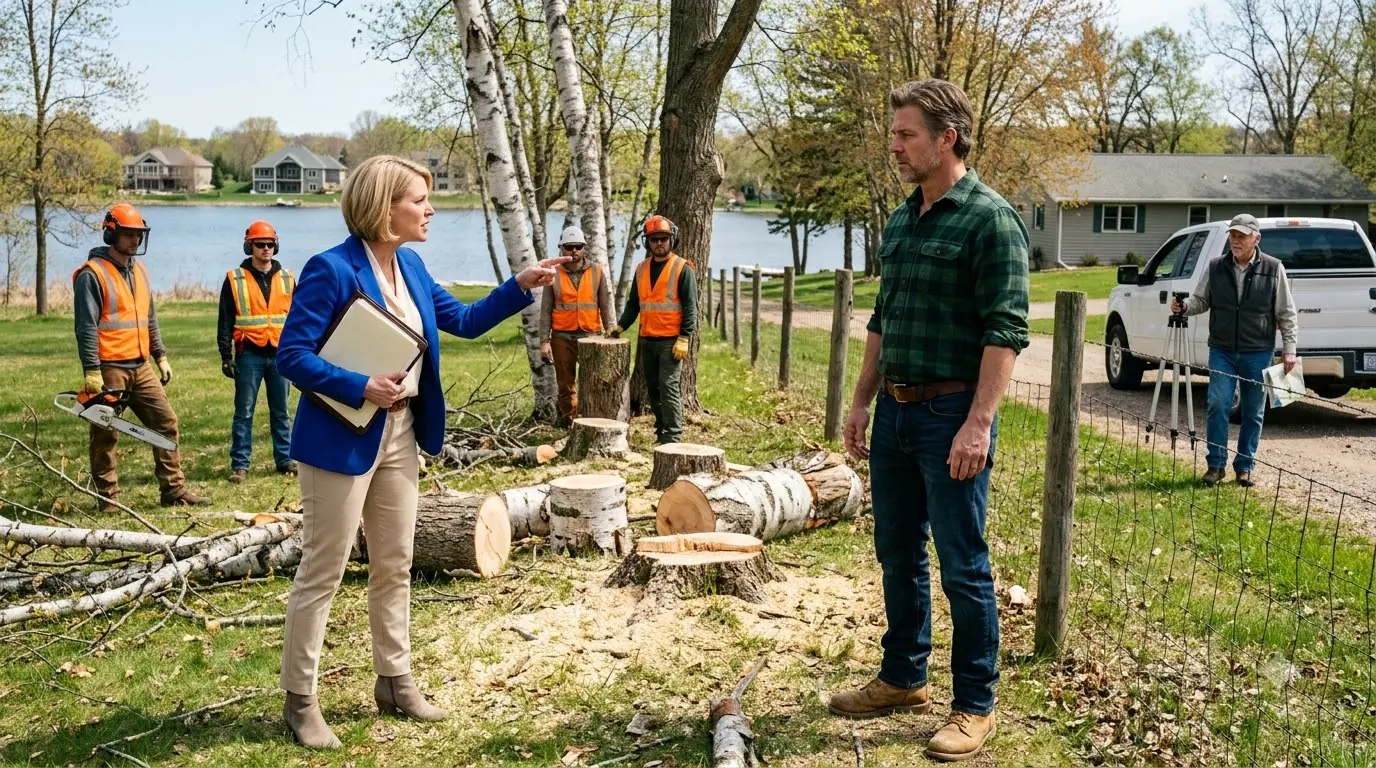
Cut down.
Eleven mature paper birch and red maple trees that had stood along the eastern side of my property for decades were reduced to fresh stumps while I slept less than two hundred yards away.
Whoever did it had brought chainsaws, a trailer, and enough people to finish the work quickly.
They took the logs.
They dragged most of the brush away.
They even raked part of the ground afterward.
If not for the pale circles of exposed wood and the smell of fresh-cut maple hanging in the cold March air, you might have thought the trees had never been there at all.
The reason was simple.
My neighbors wanted a better view of the lake.
They believed the trees stood between their expensive new deck and the western sunset.
They also believed, apparently, that wanting the view badly enough gave them some right to create it.
They were wrong.
What followed took almost two years.
Three attorneys were involved at different stages.
There was a county inspection.
A new boundary survey.
An arborist assessment.
A civil case.
A failed mediation.
And eventually a landscaping project that my neighbors will probably look at for as long as they own that house.
I did not plan the ending when this began.
For the first ten minutes, I could barely understand what I was looking at.
My name is Daniel Mercer.
I was fifty-two when the trees came down.
I own 4.2 acres in a rural county in the upper Midwest, not far from a private lake covering a little more than forty acres.
My property has been connected to my family for most of my life.
My uncle Raymond bought the acreage when I was a teenager.
Back then there was little on it except a modest house, an old detached garage, two collapsing sheds, pasture grass, and a stand of mixed hardwoods along the eastern boundary.
When I was young, I spent summers there helping Uncle Ray repair things.
Fence posts.
Deck boards.
A leaking shed roof.
A rusted trailer.
He believed children should understand tools even if they eventually chose jobs that required none.
I did.
My adult work could not have been more different.
I became a supply-chain and inventory consultant.
I helped small manufacturers understand why materials disappeared, why orders arrived late, why warehouses carried too much of the wrong item and never enough of the right one.
Most of my job involved spreadsheets, production schedules, freight invoices, and conversations with tired operations managers.
Quiet work.
Detailed work.
Work built around records.
It suited me.
When Uncle Ray decided to move south eleven years before the dispute, he offered to sell me the property.
Not give it.
Sell it.
He insisted.
“You’ll take better care of something you paid for.”
He said.
I told him that sounded like something people said to justify charging relatives money.
He laughed.
Then charged me a fair market price.
I took out a mortgage.
Recorded the deed.
Paid the taxes.
Improved the house slowly.
Replaced the roof.
Updated the well.
Rebuilt one shed.
Removed the other.
Added a porch facing the lake side.
The land remained mostly the way Uncle Ray had kept it.
Especially the trees.
Eleven of them grew in a loose natural line near the eastern boundary.
Seven red maple.
Four paper birch.
The biggest maple was nearly twenty-eight inches across at chest height.
The tallest trees reached well above the roofline.
Some were probably older than Uncle Ray.
He used to joke that they were the only residents of the property who had never once complained about taxes.
In October, they turned brilliant.
The maples went deep red and orange.
The birch became pale yellow against white bark.
Morning sun came through them in strips.
Their leaves covered half the eastern yard by November, and every year I complained while raking them.
Every year I was secretly glad there were so many.
They gave the property privacy.
Shade.
Bird habitat.
Wind protection.
But I never thought of them primarily as a screen.
They were simply part of the place.
That changed when Gary and Sandra Warner bought the neighboring parcel.
The Warners arrived four years before the trees were cut.
Their lot was slightly smaller than mine but positioned higher.
The previous house had been an unremarkable ranch-style structure built in the 1970s.
They demolished most of it and built something much larger.
Two stories.
Stone facade.
Three-car garage.
Large west-facing deck.
Walls of glass oriented toward the lake.
It was expensive.
Not grotesque.
Just clearly designed by people who expected the scenery outside to become part of the architecture.
I had no objection.
It was their land.
Their money.
Their house.
We got along normally at first.
Gary was in his mid-fifties.
Broad-shouldered.
Confident.
Commercial real estate background.
The kind of person who could turn a casual conversation beside a mailbox into a description of three office developments he had financed.
Sandra was quieter.
More polished socially.
She remembered names.
Sent Christmas cards.