“Look at him, praying to a pile of rot. That stench is going to run off every neighbor you’ve got.”
The laughter spread across the road.
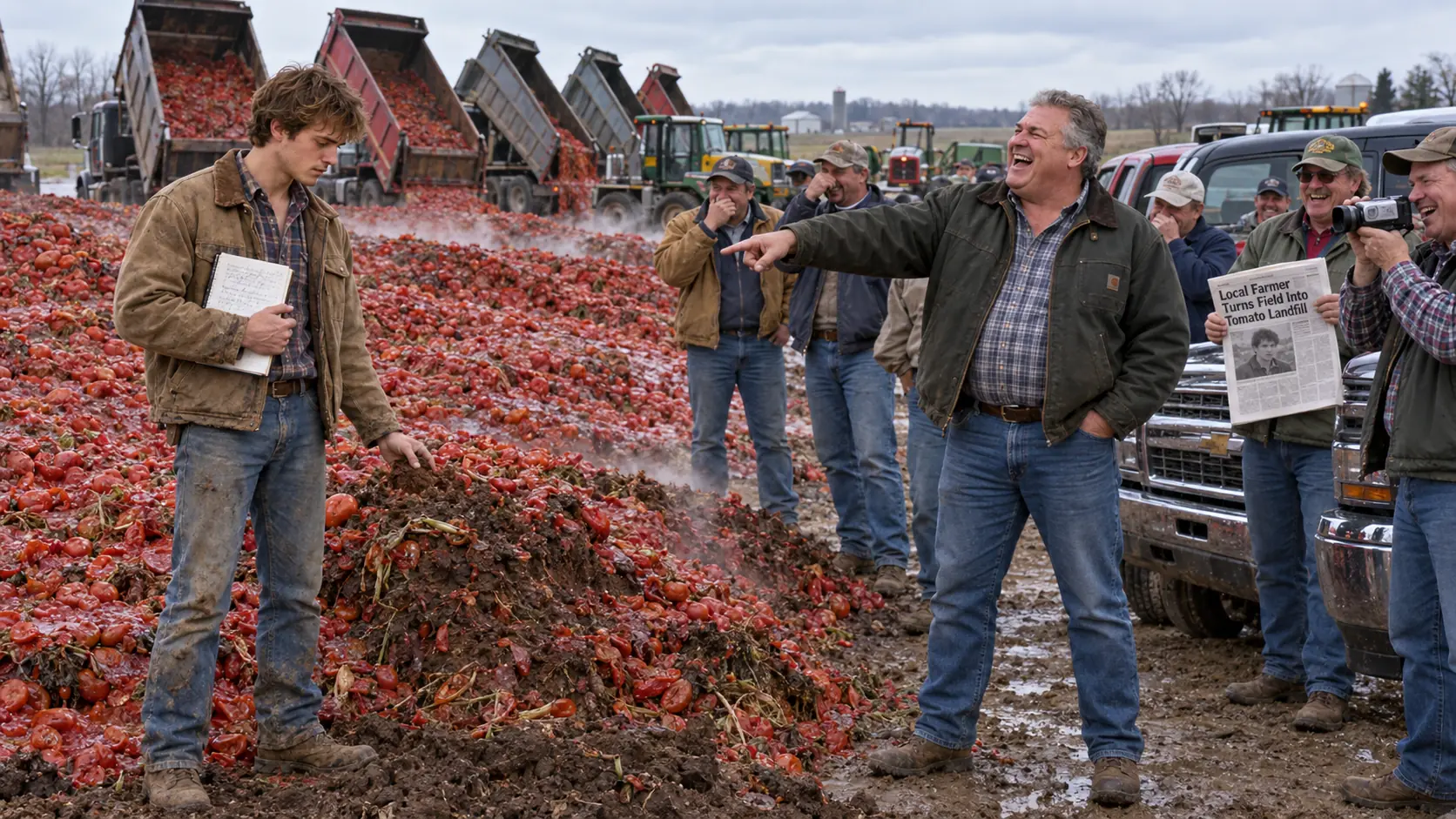
The stench was strong enough to peel the paint off an old tractor, and it was rolling across the county line at 30 miles an hour.
By noon on the second Tuesday of April, 48 commercial dump trucks had backed up to the edge of an abandoned 5-acre clay parcel on the western outskirts of Knox County, Indiana.
With loud hydraulic groans, the steel beds tilted toward the overcast sky, unloading 50 tons of fermenting crushed liquid tomato waste directly onto the cracked, lifeless ground.
It was not clean produce.
It was the industrial byproduct of a massive municipal processing purge: discarded skins, crushed pulp, bubbling acidic juices, and rotting plant matter that had sat in factory holding tanks for days until it turned into a dark crimson slurry.
Within three hours of the final dump, 22 formal complaints had been logged at the county courthouse.
Neighboring landowners gathered along the gravel shoulder of County Road 7, holding handkerchiefs over their faces and shouting at Deputy Sheriff Miller.
They demanded to know why the local zoning board had allowed an industrial cannery to turn private agricultural acreage into an unauthorized open-air landfill.
Standing quietly at the center of the controversy was 22-year-old Cole Evans.
Cole wore a faded canvas work jacket with worn cuffs and grease-stained boots.
He did not own a fleet of modern machinery.
He did not manage thousands of acres of subsidized corn.
What he owned was five acres of heavy alkaline gray clay that had sat fallow for 15 years.
Soil so packed with mineral salts and dead clay pans that local farm appraisers officially listed its commercial agricultural value at $0.
Arthur Vance, the region’s largest commercial tomato grower, a man who farmed 6,000 acres of hybrid Roma tomatoes for national supermarket chains, drove up in his brand-new dual-cab pickup truck.
Vance stepped out, glanced at the steaming sea of red waste, and burst into laughter loud enough to carry across the entire road.
“The boy has finally lost his mind,” Vance announced to the gathered crowd.
“The Midwest Canning Corporation was facing $20,000 in municipal environmental disposal fines to haul that slurry to a certified incinerator in Indianapolis.”
“Instead, they found an idiot who let them dump 20 truckloads of bio-sludge on his dirt for free.”
He looked toward Cole.
“Hey, Cole, are you planning on farming maggots, or are you just opening a public sewer?”
The crowd of growers laughed with him.
The local weekly newspaper, the Knox County Herald, ran a mocking headline on Friday morning calling the property “The Great Tomato Landfill of Knox County.”
The township trustee delivered a formal citation warning Cole that if the rotting waste was not cleared or plowed under within 30 days, the county would send municipal bulldozers to bury it and bill him for the excavation costs.
Cole signed the citation receipt with a calm hand, folded the yellow carbon paper, and put it in his pocket without offering a single word of defense.
To every farmer in Indiana, the situation was obvious.
A naive kid had been manipulated by a corporate factory looking to avoid waste treatment fees.
They saw 50 tons of stinking garbage on five acres of worthless dirt.
They laughed all through April.
They shook their heads through May.
They had no idea that every single truckload of that rotting sludge was part of a calculated biological strategy designed to exploit a multi-million-dollar loophole in modern industrial agriculture.
The knowledge that guided Cole Evans did not come from an agricultural business degree.
It came from 30 years of handwritten research conducted by his late grandmother, Dr. Clara Evans, an independent soil microbiologist who had spent her career studying traditional pre-industrial horticulture.
Clara had documented two undeniable scientific realities that the modern commercial farming industry had spent four decades ignoring.
The first was the chemistry of the dead five-acre lot.
The soil on Cole’s parcel was heavy, impermeable alkaline clay with a soil pH measuring a brutal 8.4.
In high-alkaline clay, essential micronutrients like phosphorus, iron, and zinc become chemically locked in insoluble mineral bonds.
Standard commercial fertilizers could not dissolve properly in that dirt.
They simply sat near the surface until rain carried much of them toward the drainage ditches.
To break down the alkaline clay using commercial soil amendments would have required 40 tons of agricultural sulfur and thousands of pounds of synthetic nitrogen, costing more than $30,000.
Money Cole did not have.
The industrial tomato slurry, however, offered a radically different source of organic material.
Decomposing tomato pulp had a naturally acidic character, measuring around pH 4.1 in the material Cole was working with.
It contained organic acids produced as the plant matter fermented and broke down.
When the tomato mash was incorporated into the alkaline clay, Cole expected the combination of acidity and decomposition to help change conditions in the damaged soil.
At the same time, the decomposing skins, pulp, and seeds introduced a large amount of organic carbon along with naturally occurring nutrients.
Instead of paying for truckloads of commercial amendments, Cole had arranged for the Midwest Canning Corporation to deliver the raw material directly to his field.
To the company, it was waste.
To Cole, it was free organic matter.
But the soil transformation was only the first half of his plan.
The real opportunity was hidden inside the tomato slurry itself.
Two weeks before the dumping began, Cole had quietly followed the production schedule at the Midwest Canning Corporation.
The plant had taken on a specialty contract for a European organic food conglomerate.
For seven days, the facility processed trial batches of 40 rare, open-pollinated heirloom tomato varieties gathered from heritage seed banks across Italy, France, and the American South.
These were not standard supermarket tomatoes.
Modern commercial tomatoes, like the ones Arthur Vance grew, were mostly hybrids selected for qualities that made large-scale production easier.
Thick skins.
Uniform ripening.
Mechanical handling.
Longer transportation and shelf life.
But the heirloom varieties processed during the specialty run had been maintained for different reasons.
Flavor.
History.