The first time sixteen-year-old Caleb Warren began loading other farmers’ discarded irrigation pipe into the back of his father’s rusted trailer, three men standing beside the county co-op laughed at him.
Not quietly.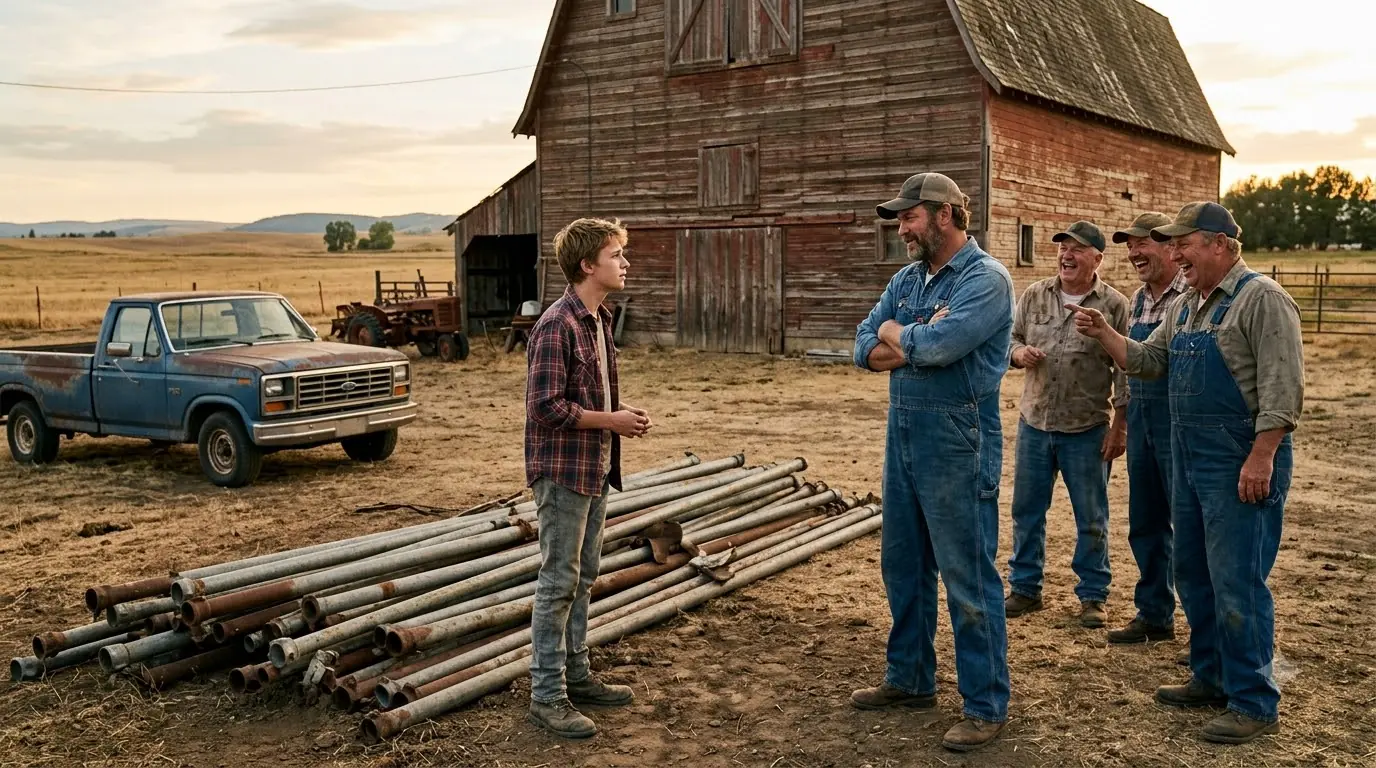
One of them leaned against a brand-new pickup and called across the gravel lot.
“Caleb, you building an irrigation system or opening a museum?”
The other men laughed.
Caleb kept lifting.
The aluminum pipe in his hands was nearly thirty feet long, scarred white by mineral deposits, dented near one coupling, and old enough that the faded manufacturer’s label could barely be read.
It had once belonged to Howard Briggs, whose family farmed more than two thousand acres west of Garden City, Kansas.
Howard had replaced nearly all of his old hand-move and gated pipe years earlier with newer center pivots and low-energy precision application equipment.
To him, the aluminum sections stacked behind the co-op were junk.
To Caleb, they were water.
Or at least the possibility of water.
That difference was why the men laughed.
Everybody in Finney County knew the Warren family was struggling.
Their pickup had rust above both rear wheel wells.
Their combine was old enough that Caleb’s father kept a coffee can filled with spare bolts under the seat because something was always vibrating loose.
Their farmhouse had needed a new roof for three years.
Their irrigation pivot had stopped running properly the previous August.
And the family’s bank had already made it clear that another large equipment loan was not going to be approved without additional collateral.
So when people saw Luke Warren’s skinny teenage son collecting retired pipe other farmers had discarded, they did not see innovation.
They saw poverty trying to disguise itself as an idea.
Howard Briggs walked over while Caleb wrestled another section onto the trailer.
“You know why we quit using those things?”
Caleb adjusted his grip.
“Because you bought pivots.”
Howard laughed.
“Exactly.”
“They’re labor.”
“They leak.”
“They’re inefficient.”
“They'll make you hate your life.”
Caleb looked at the pipe.
“Still moves water.”
Howard stared at him for a moment.
Then laughed again.
“Water moves downhill too.”
“Doesn't mean I irrigate with a bucket.”
Caleb smiled faintly.
“No.”
Howard pointed toward the pile.
“You seriously want all of these?”
“If you're actually getting rid of them.”
“Take them.”
“You’ll save me scrap hauling.”
Caleb nodded.
“Thanks.”
Howard walked back toward the other men.
One called:
“Don't forget duct tape!”
Another shouted:
“Paint them green and maybe the corn will feel encouraged!”
Caleb kept loading.
He did not defend himself.
Partly because there was no point.
Mostly because he was not sure they were wrong.
He had never built an irrigation system.
He had never managed a commercial crop.
He had never borrowed money from a bank, negotiated a crop contract, or survived a drought year with mortgage payments coming due.
He was sixteen.
He knew exactly how ridiculous that sounded.
But he also knew something the men laughing at him did not.
The Warren family’s old irrigation well still produced water.
Not enough to operate the broken center pivot efficiently at the pressure it had once required.
Not enough to irrigate all eighty acres beneath it.
But it still produced water.
And Caleb had spent the previous five weeks asking a different question.
What if the problem was not that the Warren farm had no water?
What if the problem was that the only system they owned demanded more pressure, more flow, and more money than they could provide?
That afternoon, he loaded twenty-three sections of discarded pipe.
By the time he finished, his arms shook from lifting.
His gloves were black.
His jeans had torn at one knee.
And the trailer looked like something assembled from the remains of three dead farms.
Caleb tied everything down.
Then climbed into the driver’s side of the Warren family’s 1998 Ford pickup.
The air conditioner had stopped working before he was born.
He rolled down both windows.
As he started the engine, one of the men beside the co-op lifted an imaginary glass toward him.
“To the irrigation empire!”
Caleb raised two fingers from the steering wheel.
Then drove home.
Three months later, Howard Briggs would stop his pickup beside the Warren property and stare across a field so green it looked impossible against the burned yellow prairie surrounding it.
By then, nobody would be laughing.
But on that afternoon, Caleb did not know whether the pipes would ever carry a gallon of water.
He only knew that his family had thirty-eight days before the bank reviewed their operating line.
And if Luke Warren could not show a credible plan for the next season, there might not be a Warren farm left to irrigate.
The Warren farm sat twelve miles southwest of Garden City on land Caleb’s grandfather had purchased in pieces beginning in 1974.
It was not one of the enormous operations that seemed to stretch from one horizon to the other.
The Warrens owned one hundred sixty acres.
They rented another eighty from a retired couple who had moved to Wichita.
In a wet year, it was enough.
In a good market year, it could even be comfortable.
The problem was that the previous three years had been neither.
Rainfall had been inconsistent.
Input prices climbed.
Diesel climbed.
Fertilizer climbed.
Replacement parts seemed to increase in price every time Luke walked into the dealership.
And beneath every conversation about farming in western Kansas sat a larger problem nobody could solve by working harder.
Water.
The Ogallala Aquifer had supported generations of irrigated agriculture across the High Plains.
But in many places, water levels had declined.
Older wells that once seemed impossible to exhaust now produced less.
Farmers lowered pumps.
Converted equipment.
Reduced acreage.
Switched crops.