They sold Sarah Whitmore the farm for $5,500 because everybody in Clayburn County agreed on one thing.
The land was finished.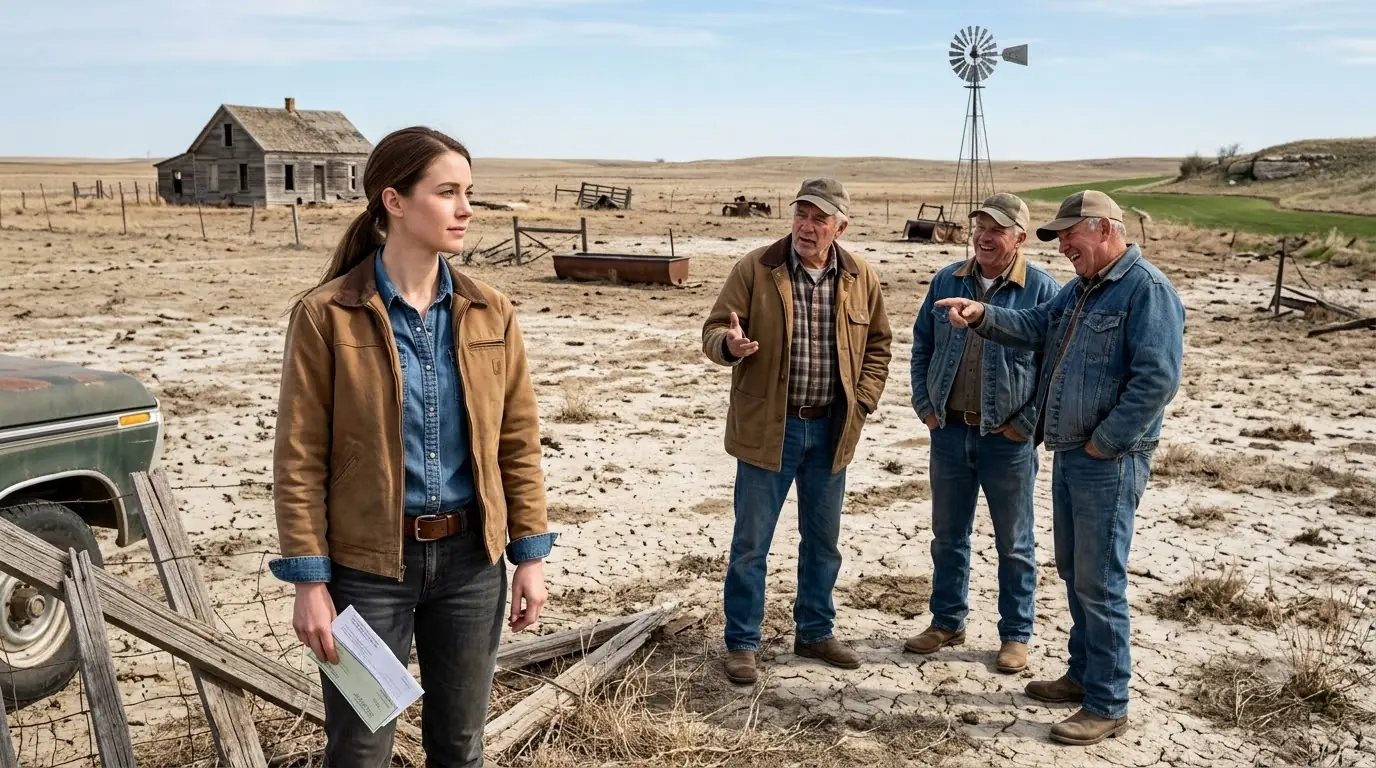
On an unusually cold April morning, Sarah stood outside the county courthouse in western Kansas with a cashier’s check held between two fingers while wind drove dust along the curb in pale ribbons.
The seller, Raymond Carter, barely looked at the check.
He was sixty-seven years old, broad through the shoulders despite the stoop that had settled into his back, wearing a brown work coat with grease-darkened cuffs and the same cracked leather boots he had probably owned for fifteen years.
He signed first.
Not eagerly.
Not angrily.
Just quickly.
The way a man puts down something he has carried beyond the point where pride can justify the weight.
The county clerk, Evelyn Tate, looked at the deed one final time.
“You both understand the transfer includes the house, outbuildings, water structures, and approximately sixty-eight acres as described in Exhibit A?”
“Yes,” Sarah said.
Raymond nodded.
“And Ms. Whitmore understands the property is being conveyed as-is?”
“Yes.”
“No warranties regarding water availability, agricultural productivity, wells, irrigation infrastructure, septic condition, outbuildings, or soil quality?”
“I understand.”
Raymond glanced at her then.
It was the first time he had really looked at Sarah that morning.
“You can still change your mind.”
Sarah smiled faintly.
“Can you?”
Raymond looked down at the papers.
“No.”
“Then neither can I.”
Evelyn slid the final page toward them.
Sarah signed.
The official consideration stated on the contract was $5,500.
That number would later become the part everyone remembered.
What people forgot was that Sarah was also taking responsibility for several thousand dollars in overdue property taxes, an abandoned farmhouse needing major repairs, a collapsed machinery shed, an unusable shallow well, old fencing, erosion damage, and land that had produced almost nothing worth selling for years.
Even so, $5,500 sounded absurd.
Raymond knew it.
Sarah knew it.
Half the county knew it.
But this was not prime Kansas farmland changing hands between eager buyers.
This was a piece of ground buyers had avoided for years because every person who looked at it saw cost before possibility.
Raymond had offered it to neighboring farmers.
No one wanted it.
A local investor offered to take it only if Raymond paid for demolition of the farmhouse first.
Another man offered three thousand dollars for the acreage without the structures and then withdrew after checking the well records.
Raymond had reached the point where getting out mattered more than squeezing out another few thousand dollars.
Sarah had reached the point where she was willing to buy the kind of land no bank officer would recommend.
That was how they met in the middle.
When they walked outside after closing, Raymond stopped beside Sarah’s dusty Ford pickup.
For a long moment, neither spoke.
The sky was low and gray.
Cold for April.
Across the courthouse parking lot, a flag snapped hard in the wind.
Raymond shoved his hands into his coat pockets.
“My father bought that place in 1968.”
Sarah waited.
“He thought there was water there.”
“Why?”
Raymond smiled without humor.
“Because everybody buying land back then thought there was water somewhere if you drilled deep enough.”
He looked toward the road.
“We put down four wells in my lifetime.”
“How deep?”
“Different depths.”
“First was shallow.”
“Second went deeper.”
“Third was supposed to solve everything.”
“It didn't.”
“And the fourth?”
Raymond laughed once.
“The fourth solved one thing.”
“What?”
“It convinced me to stop paying drillers.”
Sarah nodded.
Raymond looked at her.
“You really worked conservation?”
“Six years.”
“You know alkaline ground?”
“Yes.”
“You know what happens there in August?”
“Yes.”
“You know the south field crusts white after a hard rain?”
“I saw it.”
“That land killed wheat three times in ten years.”
“I read the yield records.”
“The west well drops by July.”
“I know.”
“The house roof leaks.”
“I know.”
“The machine shed is one snowstorm away from becoming firewood.”
“I know.”
Raymond stared at her.
“Then why?”
Sarah looked toward the northwest.
The Carter place sat nine miles outside town.
You could not see it from the courthouse.
But she pictured the hillside anyway.
The pale grass.
The shallow depression.
The one strip of green she had noticed on her first walk.
“I don't know yet.”
Raymond frowned.
Sarah opened the truck door.
“That’s why I bought it.”
He shook his head.
“You're either smarter than all of us or a lot dumber.”
“Probably somewhere inconveniently in between.”
That got a real laugh from him.
Sarah climbed into the truck.
Before she closed the door, Raymond said:
“I loved that place.”
She looked at him.
“I know.”
“No.”
He shook his head.
“I mean I really loved it.”