He didn't knock. He didn't call ahead.
At 8:47 on a cold Tuesday morning in October, Cole Whitaker walked through the revolving glass doors of Harland & Voss Engineering and crossed the polished stone lobby without slowing down.
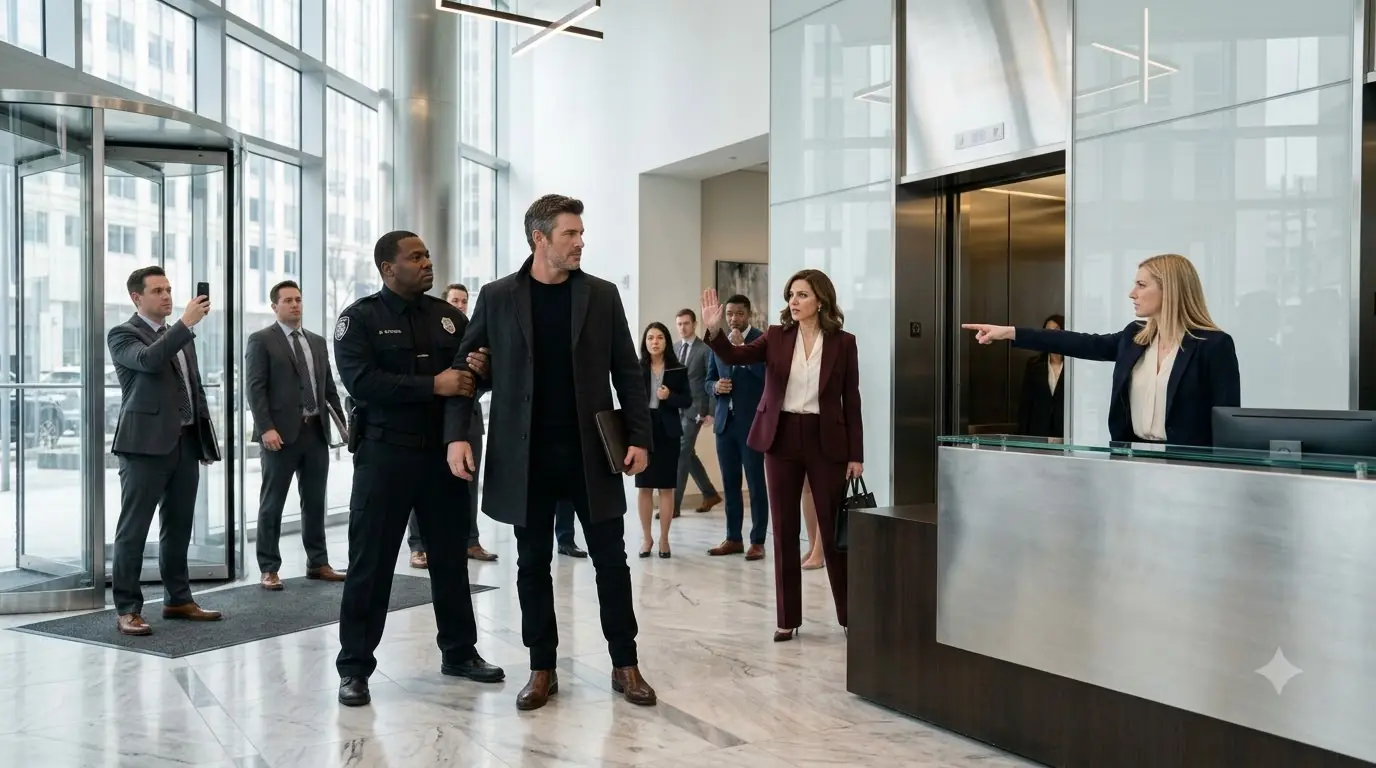
Seven years had passed since the last time he had stood inside that building.
Back then, he had been carrying a cardboard box.
This morning, he carried nothing but a dark leather portfolio.
The lobby had changed.
The old brass directory had been replaced by an illuminated digital display. The reception desk was wider now, made from pale stone and brushed steel. There were new security gates, new furniture, new photographs of bridges and commercial towers mounted along the walls.
But the smell was almost exactly the same.
Coffee.
Printer toner.
Industrial carpet.
Cold air blowing from vents hidden in the ceiling.
For one brief second, Cole remembered standing near the elevators seven years earlier while people he had worked beside for nearly a decade pretended not to see him.
He remembered the cardboard box pressing against his ribs.
He remembered Derek Poole standing twenty feet away, watching.
He remembered someone from Human Resources telling him his building access had already been terminated.
Cole stopped at the security desk.
The guard looked up.
"Can I help you?"
Cole placed a business card on the counter.
The guard picked it up.
Whitaker Construction Group.
Cole M. Whitaker.
Chairman.
The guard's expression changed almost imperceptibly.
"Do you have an appointment, Mr. Whitaker?"
"Tomorrow."
"Tomorrow?"
"With legal."
The guard glanced at him.
"Then you're a little early."
Cole looked past the desk toward the elevators.
"Seven years."
The guard didn't understand.
Cole hadn't expected him to.
"I just wanted to see the building."
The guard hesitated.
Visitors normally required escorts beyond the security line, but Cole hadn't attempted to cross it. He was simply standing there, looking.
"All right," the guard said.
Cole nodded.
Then he turned slightly.
Employees were moving through the lobby behind him.
Some were young enough that they couldn't possibly have been working there when he left.
A few were older.
One man looked familiar, but he passed without recognition.
Cole did not feel disappointed.
Being forgotten was part of what had made everything possible.
Seven years earlier, Harland & Voss Engineering had ended his career with a single word.
Fraud.
Now Cole had returned to Columbus for a different reason.
He wasn't there to argue.
He wasn't there to demand an apology.
He wasn't even there primarily for revenge.
Cole Whitaker had come back to buy the company that had destroyed his life.
And almost nobody inside the building knew it yet.
The only person who would soon begin to understand was a woman Cole had never met.
Four floors below the lobby, attorney Nadia Vale sat cross-legged on the dusty floor of a records storage room with a banker box open beside her.
She had no idea that Cole Whitaker was upstairs.
But she was holding his past in her hands.
Seven years earlier, the Bridge Corridor project had been the largest municipal contract Harland & Voss had ever secured.
Forty-seven million dollars.
The City of Columbus had approved the project to rebuild and reinforce a failing network of bridge structures across the Scioto River corridor.
Some of the bridges were more than half a century old.
Concrete had begun to deteriorate.
Drainage systems were failing.
Expansion joints needed replacement.
Several support structures required complete redesign.
For Harland & Voss, winning the contract meant prestige, expansion and access to future infrastructure work across central Ohio.
For Cole Whitaker, it meant something even more personal.
He had spent eighteen months helping build the proposal.
He had reviewed structural plans late into the night.
He had negotiated with subcontractors.
He had traveled to fabrication plants.
He had stood beneath aging bridge decks with inspection teams in freezing rain.
He had gone through hundreds of pages of material specifications and cost estimates.
He knew the project almost as well as he knew the layout of his own home.
At the time, Cole was thirty-five years old.
He had been with Harland & Voss for nine years.
He had started as a project engineer.
Three promotions later, he was overseeing major infrastructure contracts and was being quietly discussed as someone who might eventually move into senior management.
Two competing engineering firms had tried to recruit him.
Both had offered more money.
Cole stayed.
He believed loyalty still meant something.
That belief would eventually cost him almost everything.
The first sign of trouble appeared on an ordinary Thursday evening.
Most of the engineering floor had already emptied.
Cole was reviewing a quarterly subcontractor payment ledger before going home when he noticed the name Meridian Structural Solutions.