"Do you have any idea what you're doing? Dozens of our top engineers have tried to fix this. Do you have any concept of how much this machine costs?"
At 4 in the morning, the only sound on the factory floor was one machine that was supposed to be dead.
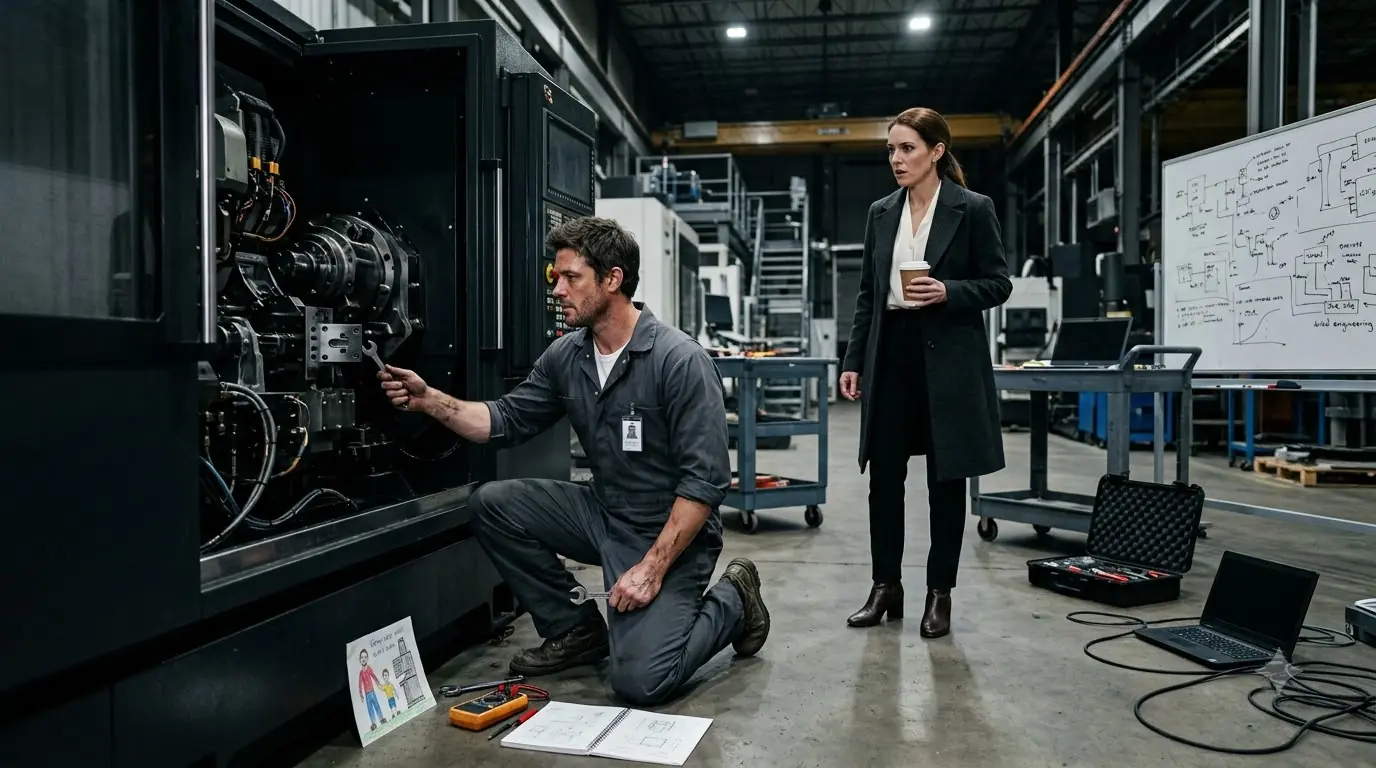
A man in gray coveralls knelt beside it, both hands buried inside an open panel, grease covering his forearms. He wasn't an engineer, at least not according to the badge clipped to his chest.
His badge said Facilities, Night Maintenance.
He had been told in front of the entire technical team that his hands were only good for holding a mop.
And yet the machine was humming.
Behind him, a voice cut through the empty bay.
"Hold it. Who are you? Nobody's cleared to touch that machine."
The man didn't turn around immediately. He finished seating one last bolt, wiped his fingers on a rag, and only then looked up at the older woman standing in the doorway.
She wore a wool coat and held a paper cup of coffee that had already gone cold in her hand.
"My name is Elijah," he said. "I work nights."
"That's not what I asked."
She stepped closer, her eyes moving from his face to the glowing green status screen behind him.
"Twelve of my engineers spent 3 days on that machine. They told me it was finished. They told me it needed a $94,000 part and 6 months of waiting."
Elijah stood slowly and placed the rag on the stool beside him.
"They were looking at the wrong part, ma'am."
The woman went very still.
Because she had heard almost those exact words before, 40 years ago, from her own mouth in a cold garage while standing over a lathe nobody else could save.
Now she was staring at a man in janitor's coveralls who had just accomplished what 12 engineers with degrees could not.
One question landed in her mind and refused to leave.
Why was a man this good mopping floors at 4 in the morning?
She didn't know it yet, but the answer would change the way she ran a company of 2,000 people.
At that moment, all she knew was that the machine was running and that everything she had been told about it was wrong.
Let me take you back to where this started.
Veil Precision made the parts you never saw but depended on anyway.
Components that went into medical scanners. Aircraft. Machines that kept people alive in hospitals two states away.
At the heart of the plant was a $2 million milling machine, 8 tons of steel capable of carving titanium to a tolerance thinner than a human hair.
For 3 days, it had been dead.
It had shut itself down midcycle and frozen on a fault code, with a half-finished part still clamped inside like a fossil trapped in stone.
Twelve engineers took turns working on it for 72 hours.
They swapped cables, reflashed software, tested systems, argued over diagnostic readings.
Nothing brought it back.
By the third day, they had an answer for management.
The main control board was gone.
A $94,000 factory replacement.
Six months of waiting.
Meanwhile, a contract with a hospital supplier was already approaching a penalty clause severe enough to threaten the jobs of 400 people.
Every one of those 12 engineers agreed.
The control board was dead.
There was no other explanation.
They were all wrong.
And the only person in the building who could see it was the man they had told to go get a mop.
Elijah Ward worked the shift nobody wanted.
He arrived at 10 at night and left at 6 in the morning, mopping concrete, wiping tool stations, emptying bins, and keeping the factory floor ready for a day crew that rarely saw him.
He wore gray coveralls, different from the blue worn by the engineers.
His badge said Facilities.
Most people who passed Elijah in a hallway didn't really see him.
He was 43 years old.
He had a 9-year-old son named Theo.
What almost nobody at Veil Precision knew was that Elijah Ward had once been an operations engineer with full certification and 11 years of experience on the floor of a larger plant across the state.
He had been good.
Better than good.
Elijah had a way of putting his hands on a machine and sensing something was wrong before the diagnostics finished loading.
He learned it from an uncle who repaired diesel engines on fishing boats.
When Elijah was young, his uncle would press the boy's small hand flat against a running motor and say, "The machine's talking. You just have to shut up long enough to hear it."
Elijah had left that world behind 3 years earlier.
Not because he failed.
Because his wife, Renata, died in the spring, fast and without warning, leaving Elijah alone with a little boy who sometimes woke in the middle of the night struggling to breathe.
Theo had severe asthma.
The nights were the hard part.
The engineering jobs Elijah was qualified for demanded long days, rotating shifts, travel, and on-call weeks that could put him a hundred miles from home during the exact hours his son might need him most.
So Elijah made a trade nobody around him understood.
He took a job far below his skill level on the one shift that allowed him to be home every morning when Theo woke up.
He walked Theo to school.
Made breakfast.
Sat beside him through difficult afternoons.