“Ma’am, I need to see some identification.”
Judge Alana Pierce paused with one grocery bag still in her hand.
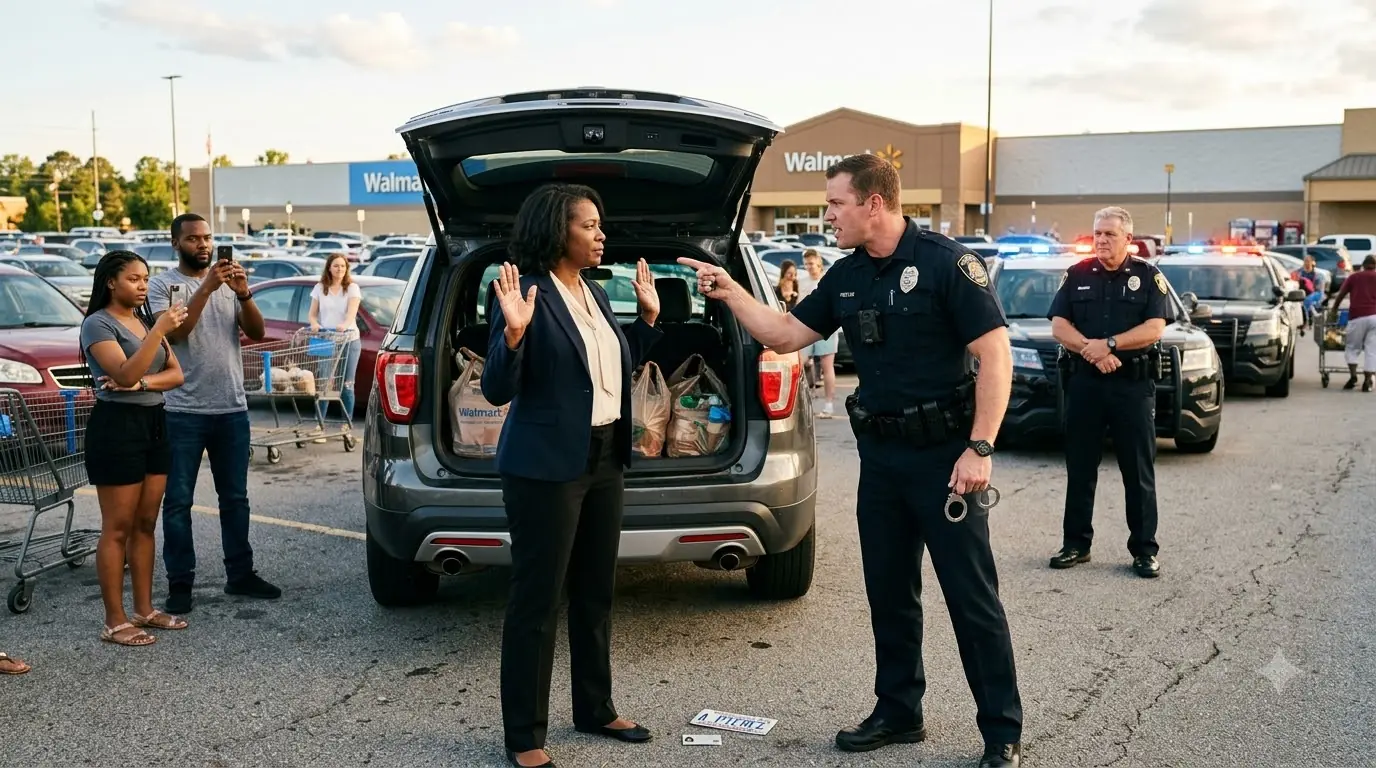
The late-afternoon heat had turned the Walmart parking lot into a sheet of shimmering gray. Shopping carts rattled in the breeze. Engines started and stopped. Somewhere near the entrance, a child was crying because his mother would not let him open a package of cookies before they reached the car.
Ordinary sounds.
An ordinary Saturday.
At least it had been until the patrol cruiser stopped behind Alana’s SUV.
She looked over her shoulder.
The officer standing ten feet away was white, perhaps late thirties, solidly built, with mirrored sunglasses and one hand resting close to his duty belt.
His nameplate read REEVES.
Alana slowly lowered the grocery bag into her trunk.
“Identification for what, Officer?”
The officer took another step forward.
“You’ve been hanging around this lot for a while, and it’s looking suspicious.”
Alana stared at him.
For a second, she genuinely thought she had misheard.
“Hanging around?”
“That’s what I said.”
“I’m loading groceries into my car.”
Officer Daniel Reeves looked past her at the dark gray Lexus SUV.
Then back at her.
“How long have you been here?”
“In the store?”
“In the parking lot.”
“Perhaps three minutes.”
Reeves studied her face as if measuring whether the answer sounded believable.
Alana noticed immediately.
She had spent more than two decades reading people under pressure.
Witnesses.
Defendants.
Attorneys.
Police officers.
Federal agents.
Jurors.
There was a particular pause people used when they had already formed a conclusion and were only waiting for the facts to cooperate.
Officer Reeves had that pause.
Alana closed the trunk carefully.
“Officer, is there a specific problem?”
“I asked for identification.”
“I heard you.”
“Then let me see it.”
Her expression remained calm.
“Have I committed an offense?”
Reeves’s mouth tightened.
“I’ll determine that.”
Something shifted inside her.
Not fear.
Not yet.
Recognition.
Alana Pierce had spent thirteen years on the federal bench.
Before that, she had been a prosecutor.
Before that, a young lawyer who had learned very early that a calm voice could be more effective than a raised one.
She understood encounters like this.
She understood how quickly they could escalate.
She also understood that being legally correct did not necessarily make you physically safe.
So she did what she had advised nervous young defendants and frightened witnesses to do for years.
She slowed everything down.
“No problem,” she said.
She reached toward the leather handbag sitting inside her open shopping cart.
Reeves’s hand moved instantly.
“Don’t reach too fast.”
Alana stopped.
Her hand remained visible.
“I’m reaching for the identification you requested.”
“I said slow.”
“I am moving slowly.”
“Keep your hands where I can see them.”
Alana looked at him for a long second.
Then she raised both hands slightly.
“Officer, would you prefer to remove my wallet from the bag yourself?”
The question seemed to irritate him.
“I didn’t say that.”
“Then please tell me how you would like me to retrieve my identification without reaching toward my purse.”
A man two parking spaces away stopped loading a forty-pound bag of dog food into his pickup.
He looked over.
An elderly woman pushing a cart slowed.
Reeves noticed the growing attention.
His tone sharpened.