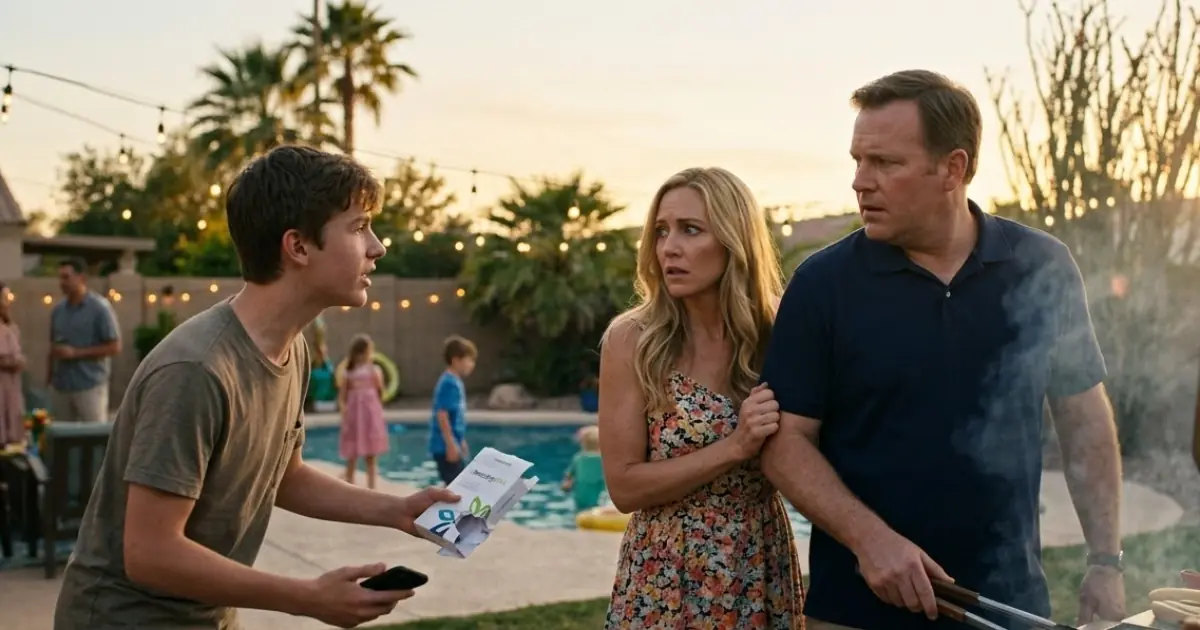
By the time the sun slid toward the jagged line of the Superstition Mountains, the heat over Mesa had loosened its grip just enough for people to stand outside without wincing. The thermometer on the back patio still read ninety-four, but it was a September ninety-four, the kind Arizonans called pleasant with a straight face, and the Dawson backyard was full.
Eric Dawson stood at the grill the way he had stood at it every Labor Day weekend for fifteen years, feet planted, spatula in his right hand, a sweating bottle of sparkling water in his left. He was forty-three, solidly built, with short brown hair that had started to gray above the ears and blue eyes that squinted against the low light. His navy polo was dark across the shoulders. He liked the grill because it gave him something to do with his hands at parties, and because from behind it he could see everything: the pool throwing back the orange of the sky, the string lights Melissa had zigzagged across the yard on Thursday, not yet lit, swaying a little in the dry wind, the folding tables with their plastic cloths weighted down by bowls of potato salad and watermelon and the seven-layer dip his sister-in-law made every year and nobody admitted to liking.
He could see his mother, Carol, seventy and stubborn about it, sitting in the only cushioned chair with her feet in a plastic tub of ice water that she called her spa. He could see his brother Mark arguing with a neighbor about the Cardinals' offensive line, and Mark's wife, Dana, refilling the cooler. He could see the children, a shrieking tangle of them in the shallow end, his nephews and the neighbors' girls and his own daughter, Lily, nine years old and fierce, wearing goggles shaped like a shark's head and attempting, for the fortieth time that afternoon, to do a handstand underwater.
And he could see Melissa.
She was by the patio door with her sister, Jenna, laughing at something, her long blonde hair loose down her back the way she wore it only on weekends. The floral dress was new, blue and yellow, the color of the lantana by the fence. She was forty and moved through a party like a hostess in a magazine, touching elbows, refilling cups, steering conversations away from politics with a lightness that Eric had never been able to learn. When she laughed she tipped her head back, and her green eyes went narrow and bright. After nineteen years he still noticed it. He flipped a burger and watched her and thought, not for the first time, that he had been luckier than a man had any right to be.
The smoke rose and bent toward the east. Somewhere a speaker was playing an old country song, and somebody had turned it up. Carol was telling Dana, again, about the time Eric had set the kitchen curtains on fire at eleven trying to make grilled cheese with a clothes iron. Lily surfaced from her handstand, choking and triumphant, and screamed for someone to tell her if her legs had been straight. Mark's twins were throwing a foam football at the neighbors' dog. The light was turning the color of honey, and the whole yard had that suspended, slightly drunk feeling of the end of a long summer, when everyone is tired and nobody wants to go home.
Eric had been about to call out that the first round was ready when the side gate banged open.