There is a category of audacity that goes beyond ordinary entitlement.
Ordinary entitlement is somebody parking in your assigned space and acting offended when you ask them to move.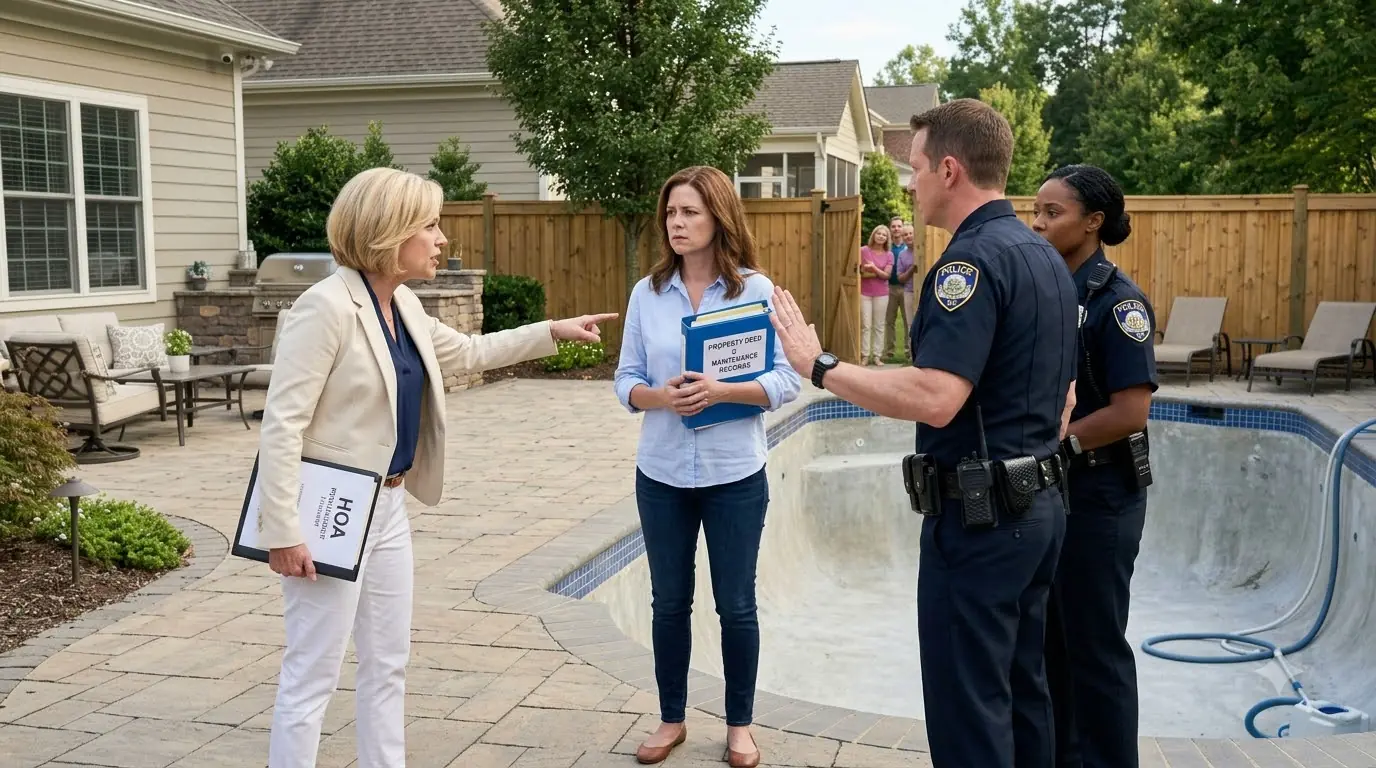
Ordinary entitlement is a neighbor hanging decorations on your fence because, in their mind, the fence exists between two properties and therefore belongs vaguely to both.
Ordinary entitlement is the daily friction of people who have slightly miscalibrated where their rights stop and someone else’s begin.
What happened to me was something different.
What happened to me was a woman spending seven months using my swimming pool without permission, forcing her way through my fence repeatedly, ignoring written notice, being warned directly by police to stay off my property, and then returning to my front door with two uniformed officers to announce that I had damaged her property by draining my own pool.
Not a misunderstanding.
Not a wording problem.
Not two reasonable people interpreting an informal arrangement differently.
By the time Sandra Fielding told Officer Martinez that my twenty-two-by-forty-four-foot in-ground pool belonged to her, she had moved completely beyond the normal relationship between wanting something and owning it.
She had used it long enough that, somewhere inside her thinking, access had transformed into entitlement and entitlement had transformed into ownership.
Fortunately for me, I am an accountant.
That may be the least dramatic sentence anyone has ever used to begin a property dispute story.
It was also the reason the dispute ended the way it did.
Because while Sandra had spent seven months building a belief, I had spent seven months building a file.
Receipts.
Permits.
Contracts.
Photographs.
Certified-mail records.
Fence-repair invoices.
Security footage.
Maintenance records.
Police incident numbers.
Insurance declarations.
Chronology.
By the time Officers Martinez and Chen stood in my kitchen looking through that file, there was almost nothing left for anybody to interpret.
My name is Rachel Pemberton.
I was forty-seven when this happened.
I bought 14 Cloverfield Road fifteen years earlier, when the neighborhood was still young enough that most of the trees were thinner than the utility poles.
The house was a two-story brick colonial with pale shutters, a narrow side driveway, and a backyard larger than it looked from the street.
The backyard was why I bought it.
I had spent most of my childhood in apartments.
We never had a yard large enough for anything more ambitious than two lawn chairs and a folding table.
When I finally became financially stable enough to buy a house, I wanted outdoor space.
Not acreage.
Just room.
Room for a garden.
Room for a patio.
And, eventually, room for a pool.
The house did not have one when I bought it.
Three years later, after saving deliberately and comparing contractors with the same intensity some people reserve for choosing surgeons, I hired Aqua Design Solutions.
The pool was not extravagant by luxury-home standards.
It was significant by mine.
Twenty-two feet wide.
Forty-four feet long.
In-ground gunite construction.
A deep end just under eight feet.
Broad steps at the shallow end.
A pale blue tile band at the waterline.
Concrete coping.
A modest heater.
A basic equipment pad behind a screened enclosure.
I chose every detail carefully.
Not because I was trying to build a resort.
Because if I was spending that much money, I wanted the thing built correctly.
The original contract was forty-one pages including specifications, warranties, payment schedule, subcontractor language, and change orders.
I still had it.
Of course I did.
The county permit lived in a labeled folder.
The final electrical inspection.
The fencing certificate.
The initial water-safety inspection.
Every annual service agreement after that.
Twelve years of invoices.
Pump replacement in year six.
Heater service in year nine.
A new salt-cell assembly in year ten.
Deck sealing.
Tile repair.
Pressure testing.
Every item dated.
Every bill paid from my account.
The pool was not an abstract amenity.
It was property.
My property.
I paid for it.
Insured it.
Maintained it.
Closed it each fall.
Opened it each spring.
Vacuumed it more often than I wanted to.
Paid chemical bills that increased every year.
Spent summer evenings floating beneath the maple trees with a glass of iced tea balanced on the coping.
The pool gave me something no spreadsheet could really quantify.
It made my house feel like the place I had imagined owning when I was younger.
That mattered to me.
Sandra Fielding moved into 16 Cloverfield Road nine years after I bought my house.
Her property sat directly east of mine.
We shared roughly one hundred twenty feet of fence line.
Sandra was in her early forties when she arrived.
Recently divorced, as I later learned.
Two children.
Mason, nine.
Ella, seven.
They were ordinary, energetic kids.
The kind who appeared outside within five minutes of hearing anyone else doing something interesting.
Sandra was harder to summarize.
She was social.
Direct.
Confident.
The kind of person who learned neighbors’ names immediately and used them often.
Within two weeks of moving in, she had opinions about the mailboxes.
Within a month, she had reorganized the informal Halloween route for the children.
By Christmas she had convinced three houses to coordinate exterior lights.
None of that bothered me.
Some people enjoy involvement.
Neighborhoods often benefit from them.
The problem with Sandra was not that she had preferences.
It was that she rarely experienced her own preferences as optional.
If she thought something made more sense, then people who disagreed were not simply people who disagreed.
They were people who had not yet understood.
The first time she asked about the pool was almost three months after she moved in.
Saturday morning.
Early June.
I was trimming lavender near the patio when my doorbell rang.
Sandra stood there with both children.
Mason had swim goggles around his neck.