"Step away from the vehicle."
Daniel Brooks stopped with one hand resting on the open rear door of his SUV.
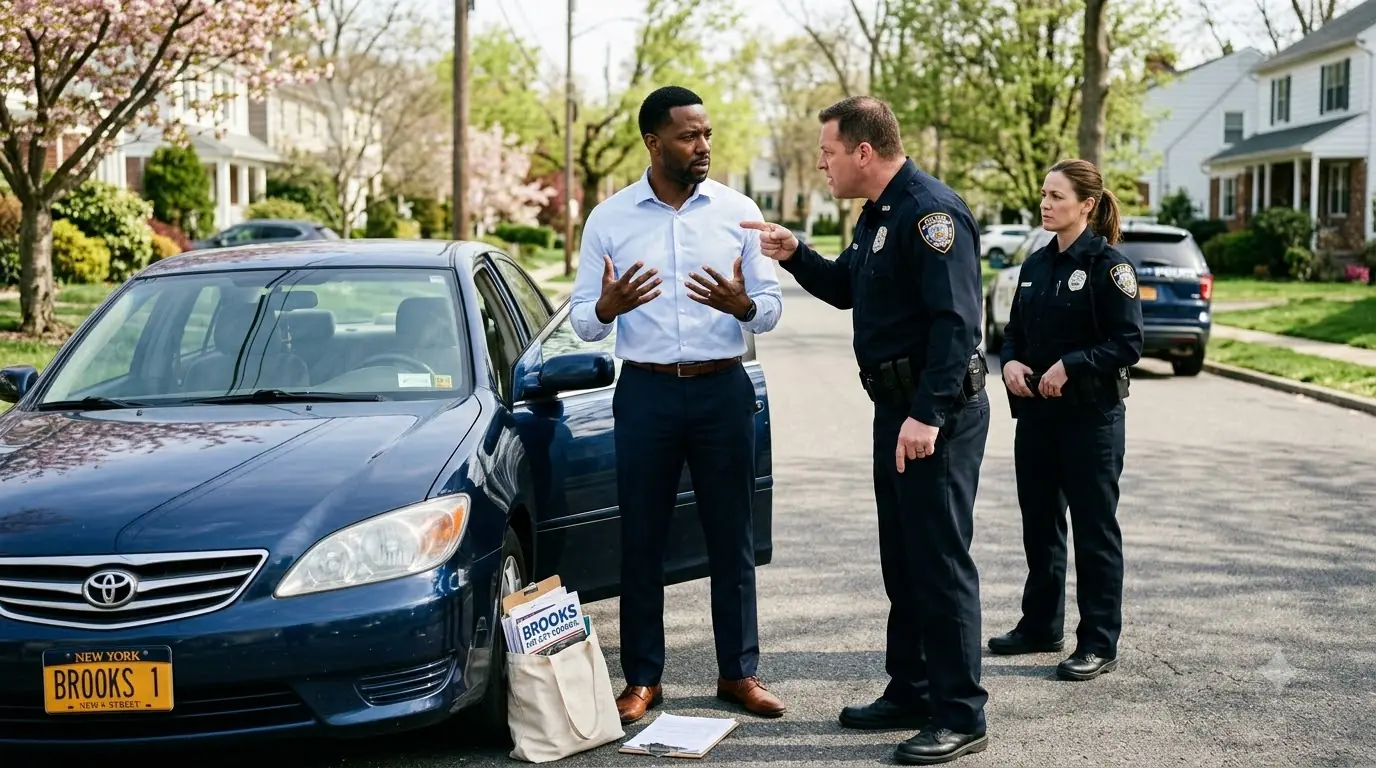
The officer approaching him had already placed one hand near his belt.
"Now."
Daniel slowly removed his hand from the door and stepped backward.
"Is there a problem, officer?"
"You match the description of someone trying door handles around here. Don't play games with me."
Daniel's eyes narrowed.
"What description?"
"Black male. Around six feet. Dark clothing. Carrying a bag."
Daniel looked down at himself.
Dark navy slacks.
Blue button-down shirt.
Canvas campaign bag.
His congressional campaign lanyard hung plainly around his neck.
Behind the officer, twelve feet away, a yard sign stood in freshly cut grass.
DANIEL BROOKS FOR CONGRESS.
The photograph printed on it was unmistakably him.
The officer had not looked at it.
"What are you doing in this neighborhood?" he demanded.
"I'm meeting volunteers."
"For what?"
Daniel kept his voice level.
"I'm actually running for Congress in this district."
The officer gave a short laugh.
"Yeah. Running for Congress. ID. Now."
Daniel stared at him for one second.
Then another.
He had stood in courtrooms opposite prosecutors who wanted his clients imprisoned for decades.
He had questioned detectives under oath.
He had argued motions before federal judges.
He had spent fourteen years learning that a single careless movement, a single badly chosen sentence, could decide whether a frightened person walked home or entered a cell.
Now all that training narrowed into one simple objective.
Do not give this man a reason to misunderstand anything.
"Officer," Daniel said carefully, "I'm going to reach into my jacket for my wallet."
The officer's posture tightened.
"Slowly. Keep your other hand where I can see it."
Daniel raised his left hand slightly.
"That's exactly what I'm doing."
The morning had begun ordinary.
That was what stayed with him afterward.
No warning.
No ominous feeling.
No sense that the next hour would change his campaign, his career, and eventually the department surrounding him.
It was a clear Tuesday in early spring, the kind of morning when American flags moved gently from porches and campaign signs dotted neighborhood lawns.
Daniel Brooks had been running late.
That was not unusual.
At forty-one, he lived according to a calendar that seemed designed by somebody who disliked sleep.
Fundraising breakfast.
Volunteer briefing.
Local radio interview.
Canvassing.
Meeting with the mayor's deputy chief of staff.
Donor call.
Policy roundtable.
Union hall appearance.
Evening town hall.
Then, if he was lucky, two hours at home before answering email until midnight.
His campaign manager, Renee Aapor, had once looked at his schedule and said, "You understand normal people eat lunch, right?"
Daniel had responded, "I have almonds in the car."
"That's not lunch."
"There's protein."
"You're impossible."
Daniel had smiled.
"So I've been told."
The campaign had been running for eleven months.
Eleven exhausting, chaotic, unexpectedly hopeful months.
Three years earlier, Daniel had never imagined himself running for Congress.
He had imagined a life in courtrooms.
Maybe eventually becoming a supervising public defender.
Possibly teaching criminal procedure at a law school part-time.
Politics had always interested him, but from a distance.
He believed policy mattered.
He also believed people who talked about policy too often forgot the names of the people living underneath it.
Daniel knew names.
That was what fourteen years as a public defender gave him.
Names.
Faces.
Families.
He remembered sixteen-year-old Malik Carter sitting beside his mother in a fluorescent courthouse hallway because prosecutors had charged him as an adult after a fight outside school.
He remembered Teresa Gomez, a fifty-two-year-old hotel housekeeper arrested after cash disappeared from a room, only for surveillance footage to establish she had never entered that floor.
He remembered nineteen-year-old Andre Walker, charged with armed robbery after a frightened eyewitness identified him from a lineup.
Daniel spent seventy-two hours rebuilding Andre's timeline.
The prosecution said Andre had been inside a convenience store at 8:14 p.m.
Daniel found sixteen people who placed Andre at his little sister's birthday party three miles away.
Photographs.
Phone records.
A timestamped video of Andre carrying a cake while everyone sang.
The jury needed forty minutes.
Not guilty.
After the verdict, Andre's mother collapsed against Daniel in the hallway and cried into his suit jacket.
Daniel remembered thinking that no law school class prepared you for the weight of another person's relief.
He had handled 237 cases before leaving the public defender's office.
Acquittals.
Dismissals.
Reduced sentences.
Losses that kept him awake.
Victories nobody wrote about.
People occasionally called him brilliant.