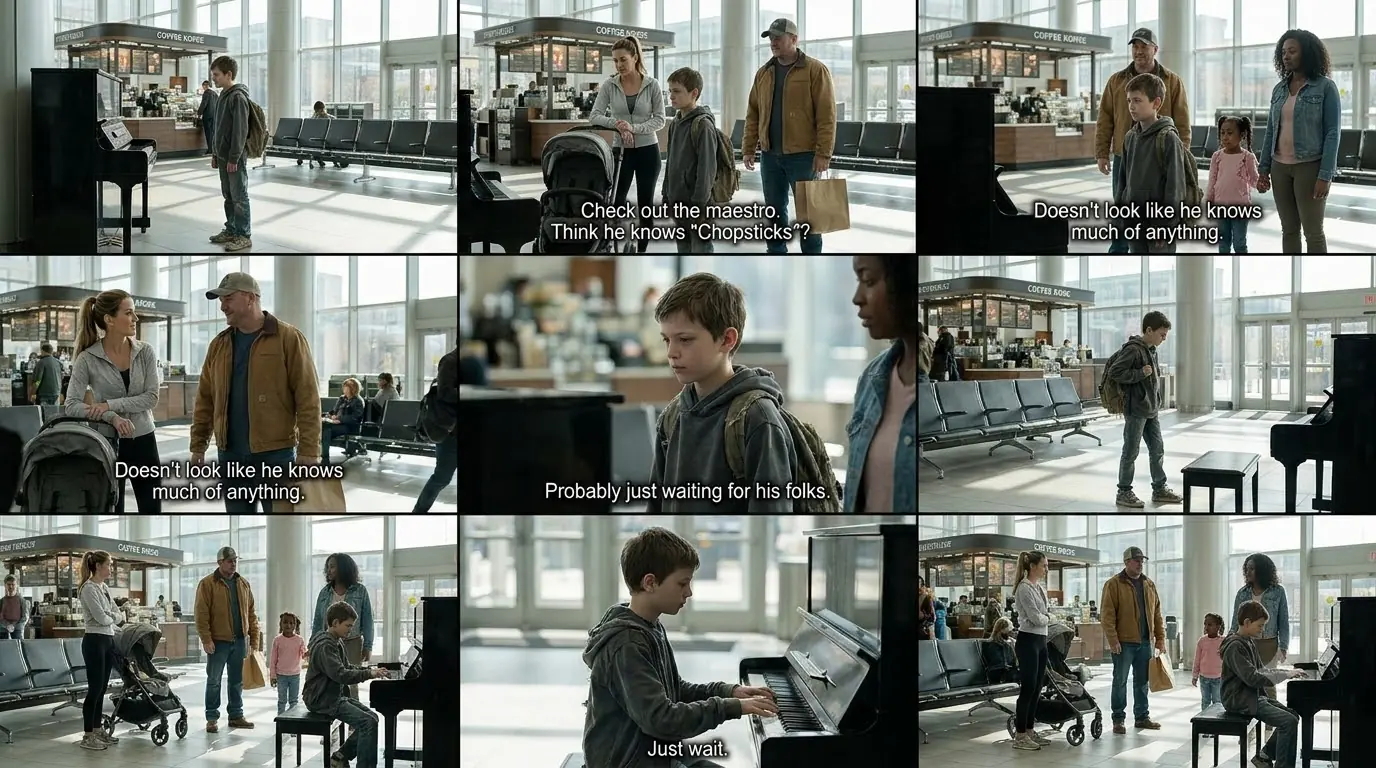
The first person to laugh at Eli Carter did not mean to be cruel. That was what she would tell herself later, and in the narrowest sense it was probably true. She was simply tired, distracted, carrying two shopping bags and a paper coffee while her seven-year-old daughter dragged a glittery backpack behind her through the bright public atrium of Union Central Station. She saw a thin boy in a worn gray hoodie standing motionless near the black upright piano, and she mistook his stillness for the kind of childish fixation adults assume they understand before a child says a word.
“Sweetie, you’re too little for that piano,” Melissa Grant said with a smirk that was meant to sound playful. Her daughter, Paige, stopped beside her and looked from Eli to the piano. Eli did not move. His messy dark hair fell over his forehead, one hand gripping the frayed strap of the backpack on his shoulder while the other hung by his side.
Around them, Saturday afternoon traffic flowed under the tall glass windows: families pulling suitcases, commuters balancing coffee cups, children hopping over grout lines in the tile, and announcements echoing beneath the arched ceiling. A broad-shouldered man in a work jacket glanced over from the nearby benches. Tom Bradley had been trying to convince his eight-year-old son to sit still for ten minutes while they waited for the northbound train, and the sight of another child staring solemnly at a piano struck him as mildly funny. “Yeah,” he said, laughing under his breath.
“Go run around with the other kids.” His son, Mason, looked embarrassed rather than amused, but Tom did not notice. A third parent had slowed near the coffee kiosk. Aisha Coleman, a Black mother in her thirties, held her daughter Zoe’s hand while balancing a stroller bag on one shoulder.
She looked at Eli with the indulgent smile adults often give children who seem to be imagining themselves into a world too large for them. “Kids your age should be playing, not chasing big dreams,” she said, patting Zoe’s shoulder. Zoe glanced up at her mother, then back at Eli, and did not smile. Eli heard every word.
He had learned, over the previous year, how to absorb remarks without showing where they landed. The trick was not to pretend they did not hurt; the trick was to put the hurt somewhere temporary and decide later what to do with it. His fingers tightened once around the backpack strap. His eyes stayed on the piano.
“Maybe you should let me decide that,” he said quietly. Melissa’s brows lifted. She had expected silence, perhaps shyness, not a calm answer. “Oh really?” she said, amused enough now to look toward the other parents for company.