Thirty-eight years in the same hospital can teach a person almost everything about the sound of a hallway.
Evelyn Brooks knew the difference between hurried footsteps and frightened ones.
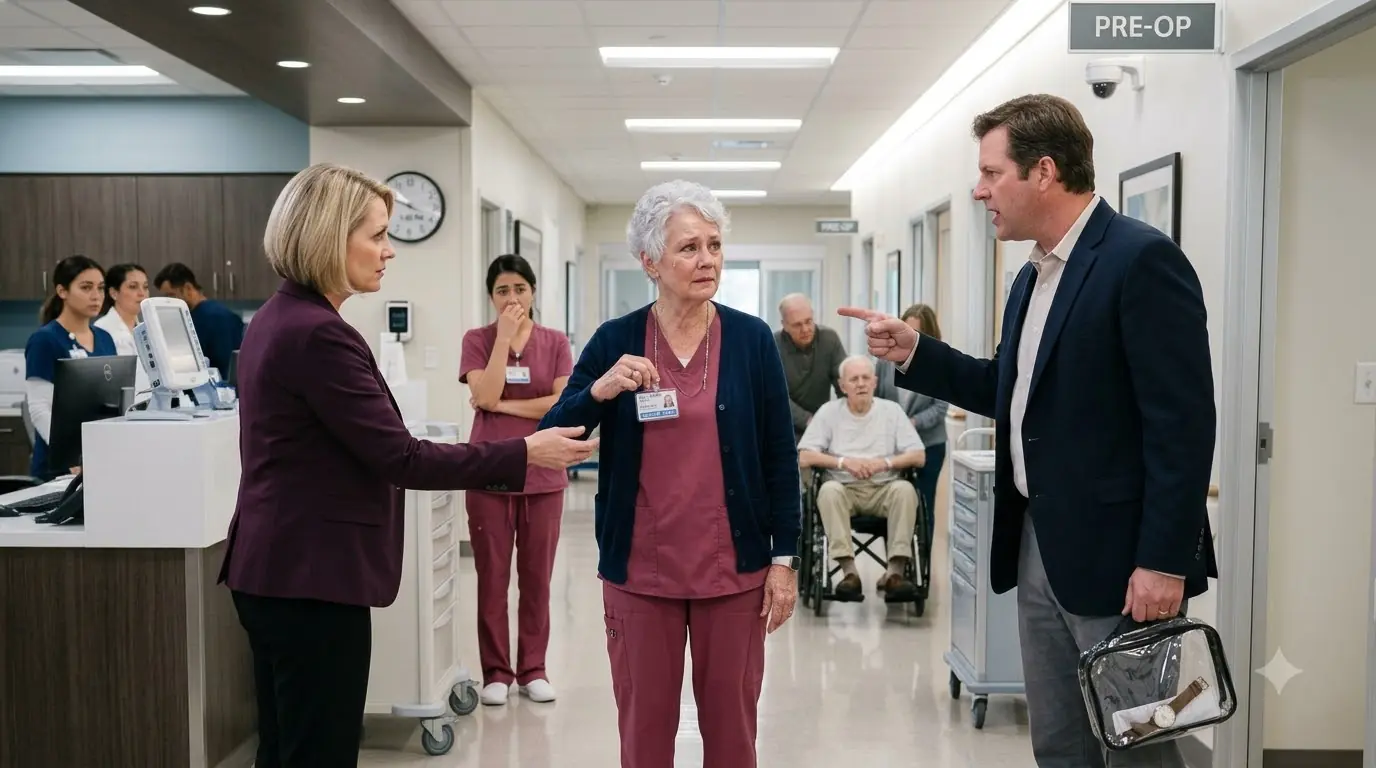
She could tell when a family had received good news by the way their voices rose near the elevators, and she could recognize bad news by the strange quiet that followed a physician out of a room.
She knew what panic sounded like before a code was called.
She knew what relief sounded like when someone finally woke up.
She knew that families became impatient when they were afraid, demanding when they felt powerless, and sometimes cruel when they needed someone, anyone, to blame.
After thirty-eight years at St. Gabriel Medical Center, Evelyn believed she had learned not to take those moments personally.
She was wrong about that.
Because on one cold November afternoon, one frightened family, one missing watch, and one supervisor who reacted before asking enough questions nearly erased four decades of work in less than fifteen minutes.
It began at 6:42 that morning.
Evelyn was sixty-four years old, though several new nurses regularly guessed younger because she still moved through the cardiac floor with the brisk efficiency of someone who had no interest in surrendering steps to age.
Her uniform was navy blue.
Her shoes were practical.
Her silver-framed glasses usually rested low on her nose when she was reading a chart.
On the left side of her chest was the badge she had worn in one version or another since Ronald Reagan was still president.
EVELYN BROOKS, RN.
CARDIAC SERVICES.
The photograph had been updated several times.
The name had not.
Evelyn arrived twenty minutes before shift change because she always did.
She put her lunch in the refrigerator, tied her hair back, checked the assignment board, and accepted report from the night nurse.
Six patients.
One complicated discharge.
One post-operative rhythm issue.
Two diagnostic procedures.
One elderly man named Howard Halstead scheduled for a cardiac catheterization just after noon.
Nothing about the day looked unusual.
Her younger colleague, Maya Patel, came through the nurses’ station carrying two coffees.
“One day,” Maya said, “I’m going to arrive before you.”
Evelyn did not look up from the medication record.
“No, you're not.”
“I could.”
“You won't.”
“You have no faith in me.”
“I have thirty-eight years of evidence.”
Maya placed one coffee beside her.
“Black, one sugar.”
Evelyn finally looked up.
“You may be late, but you are trainable.”
Maya laughed.
Evelyn had begun nursing forty years earlier at a small community hospital across town.
Two years later, she transferred to St. Gabriel.
She had spent twelve years in medical-surgical nursing, eight in step-down, and the rest on the cardiac service.
She had worked through blizzards.
Power failures.
A flood in the west wing.
Three hospital renovations.
Five electronic charting conversions.
Two labor strikes that she refused to cross until an agreement was reached.
A pandemic.
And the death of her husband.
Arthur Brooks had died six years earlier after a stroke.
For thirty-one years, Evelyn would come home from shifts and complain about hospital food while Arthur pretended to be horrified that medical professionals served mashed potatoes from a box.
After he died, Evelyn discovered retirement sounded less like rest and more like too much silence.
So she stayed.
Not because she needed the money.
Though it helped.
She stayed because she was still good at the work.
Because there were things younger nurses knew that she did not, and things she could recognize before they knew what they were looking at.
Because when a frightened patient asked whether everything would be all right, Evelyn understood that answering honestly mattered more than answering quickly.
And because some mornings, when the hospital doors opened and that familiar antiseptic smell met her, she still felt she belonged.
Howard Halstead arrived on the floor at 8:11.
Seventy-nine years old.
Retired high school principal.
Gray hair.
Thin shoulders.
A voice that remained authoritative even while he was wearing a hospital gown.
His son Mark accompanied him.
So did Howard’s daughter, Laura.
The family had been told repeatedly that the procedure was routine.
Nobody in the family believed the word routine.
Families rarely did when the person on the stretcher belonged to them.
Evelyn entered Howard’s room carrying his morning medications and found him arguing with Mark about a television remote.
“The volume is fine.”
Howard insisted.
“It’s on thirty-eight.”
Mark said.
“Thirty-eight is fine.”
“The entire floor can hear it.”
“Then maybe they'll learn something.”
The television was showing a documentary about the moon landing.
Evelyn looked between them.
“I’m staying out of this.”
Howard pointed toward her.
“Finally, a sensible person.”
Mark sighed.
“Don't encourage him.”
Laura sat beside the window with a cup of coffee.
“Too late.”
Evelyn checked Howard’s wristband.
“Mr. Halstead, remind me why you're here.”
Howard gave her an irritated look.
“You've asked me three times.”
“And you're still answering correctly.”
He sighed.
“Cardiac catheterization.”
“Good.”
“Any allergies?”
“Penicillin.”
“Who is this?”
She pointed toward Mark.
“My son.”
Mark raised one hand.
“And her?”
“My daughter.”
Laura smiled.