From that day on, whenever Dana worked late at the community center or picked up extra hours elsewhere, Ethan sat with Arthur Levin for forty-five minutes at a time learning posture, listening, rhythm, and patience. Mr. Levin did not sentimentalize talent. He believed most children quit because grown-ups lied to them—either by calling them gifted too early or by deciding too early that they were not.
He repaired castoff instruments, rehaired cheap bows, and taught scales to any child willing to repeat them without self-pity. Ethan stayed. That alone distinguished him. By age nine he could hold a phrase with unusual maturity. By ten he had moved from rough beginner books into real repertoire and practiced in the laundry room of their apartment complex because the tile echoed and the neighbors complained less there.
Arthur Levin died in January of a stroke so sudden that Ethan spent several weeks half expecting him to bark corrections from behind any closed door. Dana took him to the memorial service at a small synagogue social hall where former students, gray-haired colleagues, and two bewildered maintenance workers from the community center ate sponge cake and traded stories about Arthur’s temper, precision, and hidden generosity. Near the end, a woman named Naomi Chen approached Dana with a folder. She was Bellcroft’s director of strings outreach and had known Arthur professionally for years. Before his death, Arthur had sent her a recording of Ethan playing and a letter so direct it seemed carved into the page.
“If you still claim you want children with real ears rather than children with polished parents,” Arthur had written, “listen to this boy before some public-school budget cuts bury him under common sense.” Naomi Chen did listen. Then she called Dana two weeks later and explained that Bellcroft had a small scholarship fund and a trial placement system for students from outside the academy. Ethan would have to audition, interview, and keep up academically. He would also, if accepted, enter an environment built largely for families wealthier and more connected than theirs. Dana nearly said no. Ethan was the one who said yes.
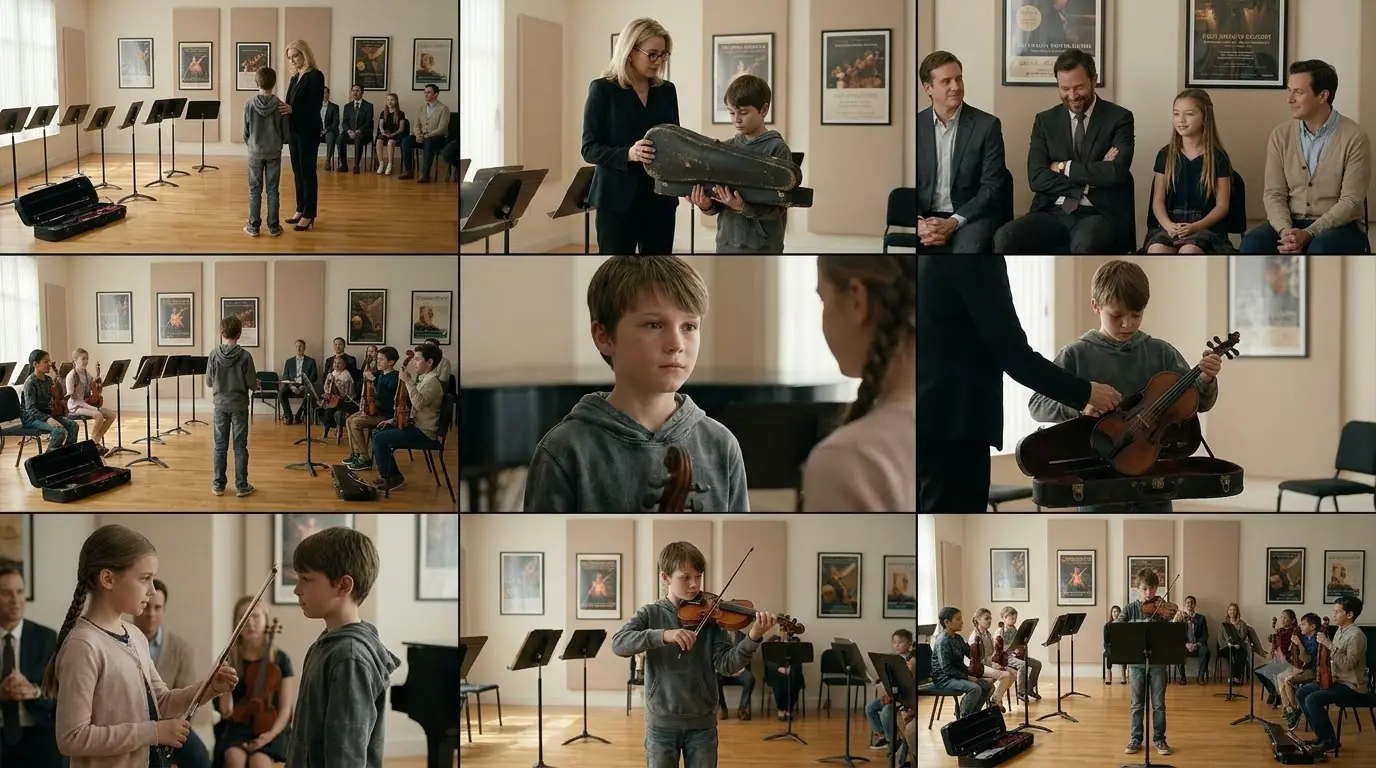
The audition took place in March in a room smaller than the one where everything later happened. Naomi Chen, a pianist, and Bellcroft’s senior violin instructor, Victoria Sterling, listened while Ethan played an unaccompanied movement of Bach and a simple lyrical piece Arthur had loved because it punished sentimental phrasing. Ethan’s hands shook for the first twenty seconds. Then something older than confidence took over.
He played the only way he knew: as if the room did not matter once the sound existed. When he finished, Naomi Chen wrote for a long time. Victoria Sterling, a woman with neatly pinned blonde hair, glasses, and an economy of movement that suggested a life spent identifying errors quickly, asked him where he had studied. “At the East Grant Community Center,” Ethan replied.